LongData.ai
IN DEVELOPMENTThe Agentic AI data engineering foundation
Business teams define the objective and the definitions in business language. Agents complete the whole delivery inside a framework and a set of implementation patterns fixed in advance by human experts, and every run is verified deterministically.
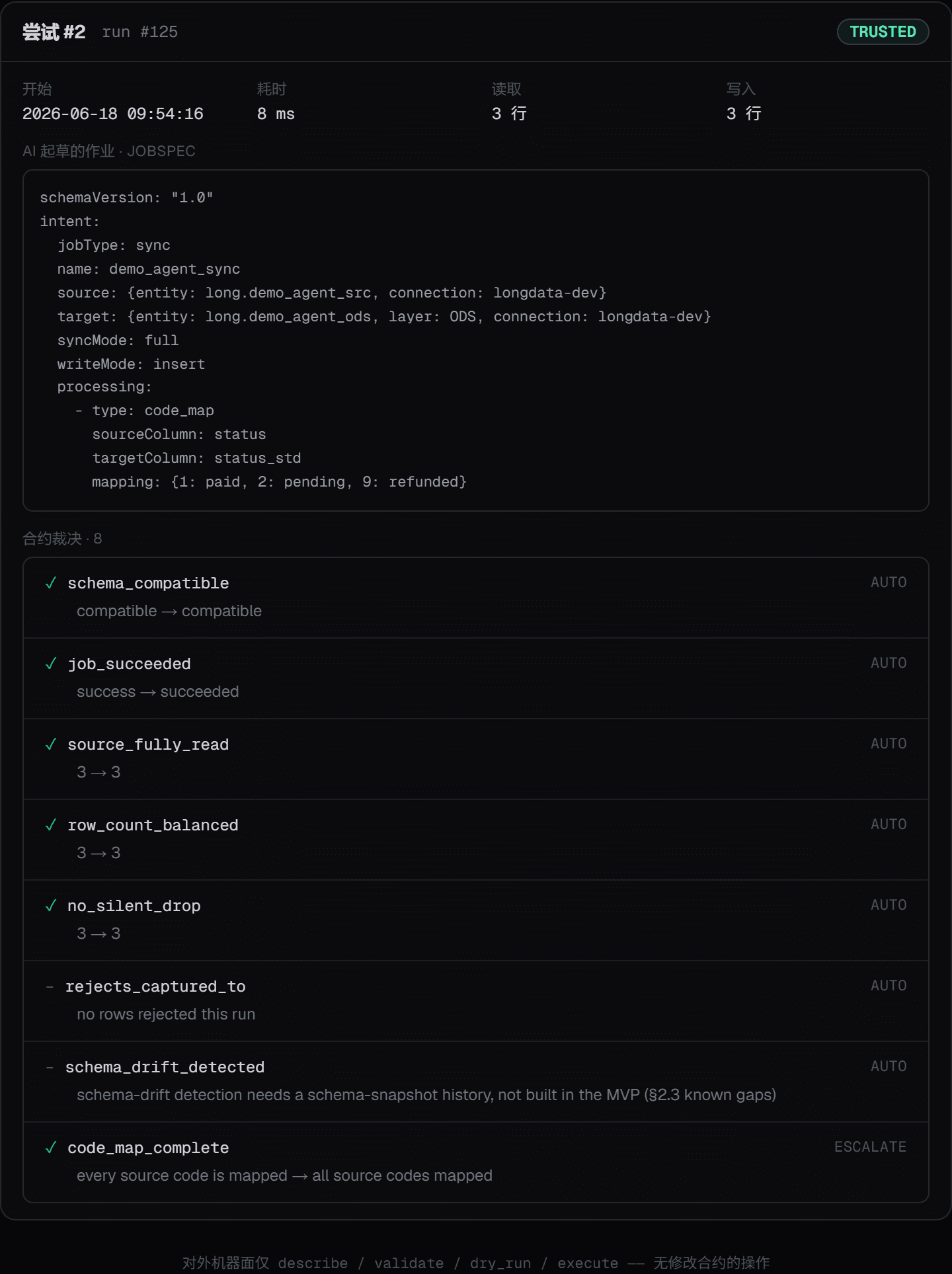
A real run: the job the agent authored, and every contract that judged it.
The problem
Data investment is growing, but delivery remains constrained by resources and process
Data engineering costs span business analysis, development and operation: defining the business problem, eliciting requirements, agreeing definitions and acceptance criteria, accessing data, building and verifying jobs, releasing them and keeping them running. Market research shows that teams and AI investment are growing, while maintenance, staffing and foundational data practices still consume substantial resources.
Investment is rising, but resources remain tight
In Deloitte's 2025 CDO survey, 54% of respondents had expanded their data teams in the previous year and 63% expected further growth; 48% still cited budget and resource limits as a key challenge to AI adoption.
Maintenance consumes half of engineering time
Fivetran's survey of 500 data and technology leaders at large enterprises found that engineering teams spend an average of 53% of their time maintaining data pipelines.
Fivetran — Enterprise Data Infrastructure Benchmark 2026 · 500 large-enterprise leaders ↗
AI is concentrated in coding
In dbt Labs' survey of 363 practitioners and leaders, 72% prioritized AI-assisted coding, while only 24% prioritized AI-assisted pipeline management, including testing, observability and quality control.
dbt Labs — State of Analytics Engineering 2026 · 363 respondents ↗
Quality and governance remain foundational
In BARC's global survey of 1,795 participants, data quality management ranked second and data governance fourth. AI and automation have not displaced these foundational priorities.
BARC — Data, BI & Analytics Trend Monitor 2025 · 1,795 participants ↗
LongData.ai redesigns the entire delivery from business requirement to production. Business analysts define objectives, business meaning, rules and acceptance criteria in business language; agents structure the requirement and use the platform's built-in movement, transformation, reconciliation and operating capabilities to decompose the project, build it, verify it and revise it. When meaning is unclear, the system stops for a business ruling, and the signed answer becomes reusable knowledge. Once the project meets its criteria, it is frozen into fingerprinted artifacts with acceptance evidence, signed once and run in production as fixed code. It automates coding, testing and repair while reducing repeated handoffs, project-specific engineering and long-term maintenance, extending automation across the full data delivery.
Product concept
The product rests on five technical foundations.
LongData.ai automates the development of data engineering work itself, turning requirements written in natural language into pipelines that are executable, verifiable and auditable. Five technical foundations support that process, and it does not hold without any one of them.
Harness
The complete environment the model works in: the range of capabilities it can call, the test that judges each step, and the mechanism that stops it at the boundary, all defined in advance by human experts.
Implementation quality is determined by the environment rather than by a single model run.
Loop engineering
Draft an implementation, judge it by contract verdicts, sample comparison and structural checks, feed the failure back together with that implementation when it falls short, and stop when the budget is exhausted. Five loops, one for each kind of output.
A model that hallucinates still converges on a passing result within a bounded budget.
Business semantics
Definitions and meaning are declared through a structured semantic protocol, verified independently and retained long term, rather than embedded in a SQL implementation.
Requirements can be checked by machine, and meaning survives staff turnover.
Industry knowledge
Business rulings and established industry practice enter the business Skills knowledge base through a single human signature, and are then supplied to every generation.
Delivery speed and accuracy rise as usage accumulates.
AI-native data engineering framework
A data engineering framework designed from scratch, simple and reliable, with the common infrastructure and tooling of data engineering built in.
It safeguards the efficiency and accuracy of the AI agent.
The first four determine whether an agent can complete a delivery on its own; the fifth determines how much room it has to get things wrong.
Delivery process
From a requirements document to a pipeline in production.
Delivery is measured in projects that can be put into production, each holding its semantic declarations, implementations, entry point and acceptance evidence.
Development
A business analyst states the objective, the definitions and the meaning of the fields in business language, and supplies a few samples of what a correct answer looks like. No template is required. The agent decomposes the work into nodes and waves, completes each implementation, runs it against the development database, reads the verdicts and revises until everything passes.
Interception
When a piece of business meaning has never been defined, the run stops, the root cause is named, and a ticket goes to the business for a ruling. The agent does not guess. The answer becomes a knowledge entry, so the same question is not raised again.
Sign-off and production
The finished implementation is frozen into fingerprinted artifacts and packaged as an acceptance evidence pack: semantic declarations, sample results, contract verdict history and assertion coverage. One signature promotes it to production, where fixed code runs with no model involved.
Run verdict
Every run is judged item by item, and only a full pass counts as trusted.
- PASS
schema_compatiblethe target structure holds every source value without loss
- PASS
row_count_balancedsource read = target written + rejected + filtered
- PASS
no_silent_dropdiscarded rows are recorded with their reason
- STOP
code_map_completean undefined source value is escalated to the business for a ruling
Fourteen contracts ship with the platform and are attached automatically by job type. Agents can read a verdict; they cannot modify the contract or the verdict itself.
Platform capabilities
Eight engineering capabilities for data delivery
Connections and metadata
Manages data-source connections and automatically collects and refreshes metadata for tables, fields and keys, providing a consistent basis for target creation, development, verification and cataloguing.
Target schema management
Generates target tables and schema-evolution plans from source metadata. Additive and widening changes are supported; changes that could lose data are referred for human handling.
Batch and continuous synchronisation
Supports full and incremental synchronisation, and consumes output from change-data-capture tools for continuous updates. Watermarks, idempotent writes and soft deletes keep target state consistent.
Transformation and cleansing
Supports field mappings, expressions, row-level functions, cross-table joins and aggregation, with computation pushed down to the data engine wherever possible.
Pipeline choreography
Organises ingestion, cleansing, transformation, reconciliation and other jobs into complete pipelines based on their data relationships, coordinating execution and hand-offs across stages so complex data projects can run continuously.
Data governance
Automatically records each data asset's business definition, data lineage, quality conclusions, access and accountability changes, keeping governance information aligned with the production environment, traceable and reviewable.
Data quality
The platform includes a built-in data quality assessment system that scans target data against data quality standards and generates a data quality assessment report.
Reconciliation and verification
Supports row counts, column totals, key sets and row-by-row reconciliation, with contracts applied automatically by job type to provide an explicit result for every run.
Governance and data assets
Governance records and data assets take shape continuously in operation
Data governance depends on clear definitions, provenance, quality, access and accountability. LongData.ai embeds the records that carry those requirements into everyday development, operations and release, so the asset catalogue, semantic versions, run and verification results, and sign-off and promotion history are produced and updated by the work itself.
Continuously updated asset catalogue
The platform continuously captures databases, tables, columns and keys, and reflects source-structure changes as they occur, so the catalogue stays aligned with the actual data environment.
Versioned semantic declarations
Field definitions, metric definitions and processing rules are declared separately and retained by version. Changes take effect through sign-off, and each batch can be traced to the semantic version used at the time.
Run and verification results
Each run records its input range, processing logic, verification items and verdicts. When an exception occurs, its affected scope and cause are retained with the result for later review.
Sign-off and promotion records
Business rulings, acceptance sign-offs and production promotions retain the actor, time and state, making key decisions and their associated responsibility auditable.
Who it is for
For organisations that collect, transform and verify data as standing work.
Data is now operating infrastructure: business systems run on it, management decisions rest on it, external commitments are evidenced by it. As volumes and sources keep expanding, collecting, cleansing, transforming, integrating and verifying that data becomes a standing engineering commitment. That commitment is what LongData.ai assumes.
Enterprises of every kind
From business systems to management analytics, from customer operations to AI applications, every layer of capability rests on trustworthy data. The more systems and sources involved, the higher the demand for integration and consistent definitions.
Government and public institutions
Administration, regulation and public services depend on data gathered and exchanged across departments, and must satisfy requirements for verifiability and traceability.
Education, research, healthcare and civil-society institutions
Research findings, clinical records and institutional archives hold value over long horizons, requiring data that remains complete, accurate and open to re-verification years later.
Software companies, data service providers and systems integrators
With data systems as the deliverable, they build and operate across many customers and environments, giving them the most direct interest in standardisation and reuse.
The value they share
Business models differ; the core of data engineering does not: ingestion, synchronisation, transformation, cleansing, reconciliation, quality verification, governance and delivery. LongData.ai consolidates that core into a general-purpose foundation: project development is carried out by agents, and correctness is verified item by item by deterministic contracts.